

The challenge facing modern banks.
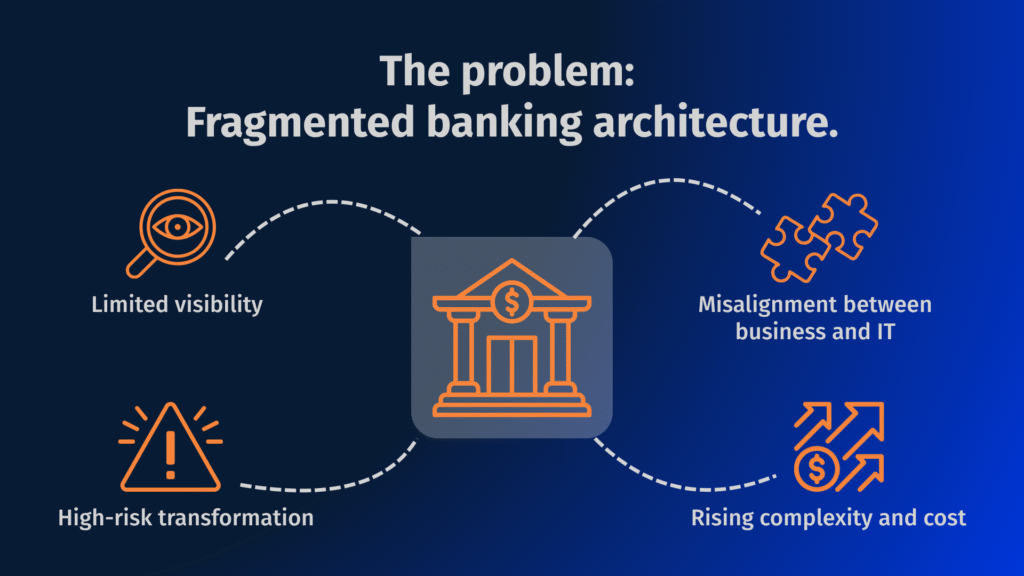
Banking architecture is under pressure. Legacy core systems, digital channels, regulatory demands and open banking initiatives have created highly complex and fragmented environments. Many financial institutions are managing hundreds of applications, overlapping capabilities and disconnected data flows.
The result is familiar:
- Limited visibility across the enterprise
- Misalignment between business and IT
- Slow, high-risk transformation programmes
- Increasing cost and complexity
For most banks, the problem isn’t a lack of frameworks, it’s a lack of clarity.
What is ArchiMate®?
Developed by The Open Group®, ArchiMate is a globally recognised enterprise architecture modelling language that enables organisations to describe, analyse and visualise their architecture in a consistent way.
It provides a structured way to model business capabilities, processes, data, applications, services, technology, infrastructure and other enterprise elements:
- Business processes and capabilities
- Logical and physical data assets
- Applications and services
- Technology and infrastructure
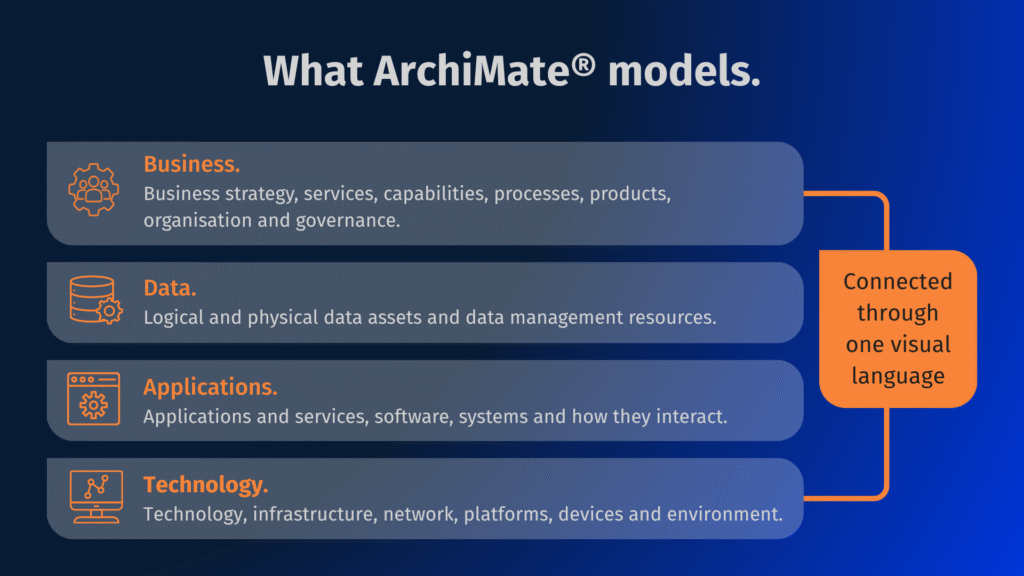
More importantly, it connects them. Rather than relying on disconnected diagrams or spreadsheets, ArchiMate introduces a common visual language that helps stakeholders understand how strategy, operations and technology interact and align.
The problem ArchiMate solves.
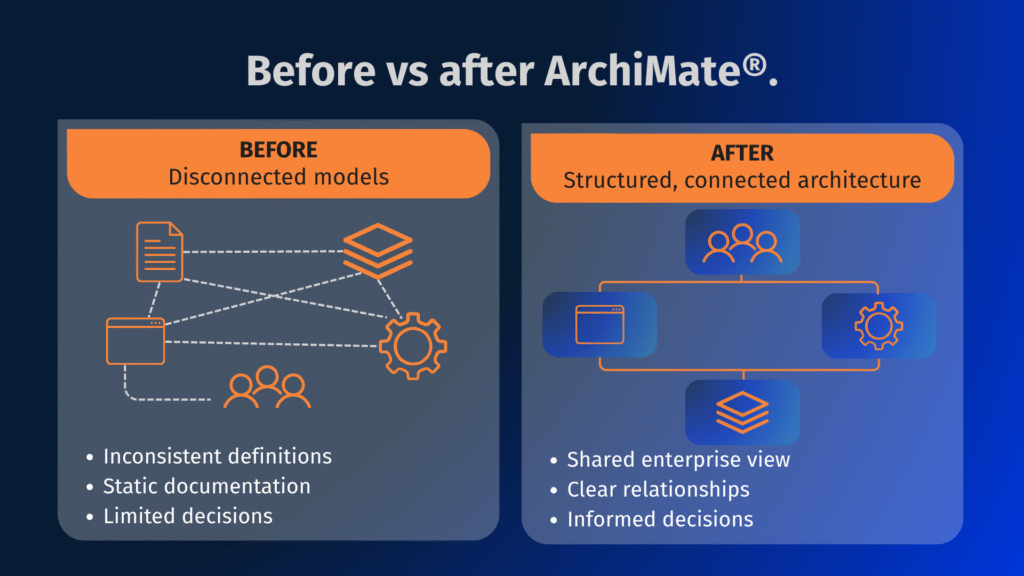
In many banks, different teams document systems in different ways, using different definitions. Models are inconsistent, static or too technical to support decision-making.
This lack of alignment causes transformation initiatives to slow down, duplication of systems and capabilities and uninformed decision-making.
ArchiMate addresses this by introducing structure, consistency and traceability. It enables organisations to:
- Create a shared view across business and technology
- Clearly model relationships between capabilities, systems and data
- Communicate architecture effectively to all stakeholders
- Support informed, enterprise-wide decision-making
In short, it turns architecture from documentation into a strategic tool.
What is BIAN?
The Banking Industry Architecture Network (BIAN) is a standardised reference architecture for banking and financial services.
Developed by a global collaboration of banks, technology providers and industry participants, BIAN provides a common reference model for structuring banking capabilities into service domains with defined responsibilities and interactions.
At its core is the BIAN Service Landscape, a structured map of banking capabilities organised into modular, non-overlapping service domains. Each service domain represents a discrete business function (for example, payments, customer onboarding, or product management) with clear responsibilities and defined interactions.
This gives banks a common, industry-aligned blueprint for their architecture.
Why ArchiMate® and BIAN matter together.
BIAN and ArchiMate solve two different, but complementary, problems.
- BIAN provides the banking reference content
- ArchiMate provides the modelling language to represent it coherently
BIAN has been formally expressed using ArchiMate, reinforcing how closely the two align.
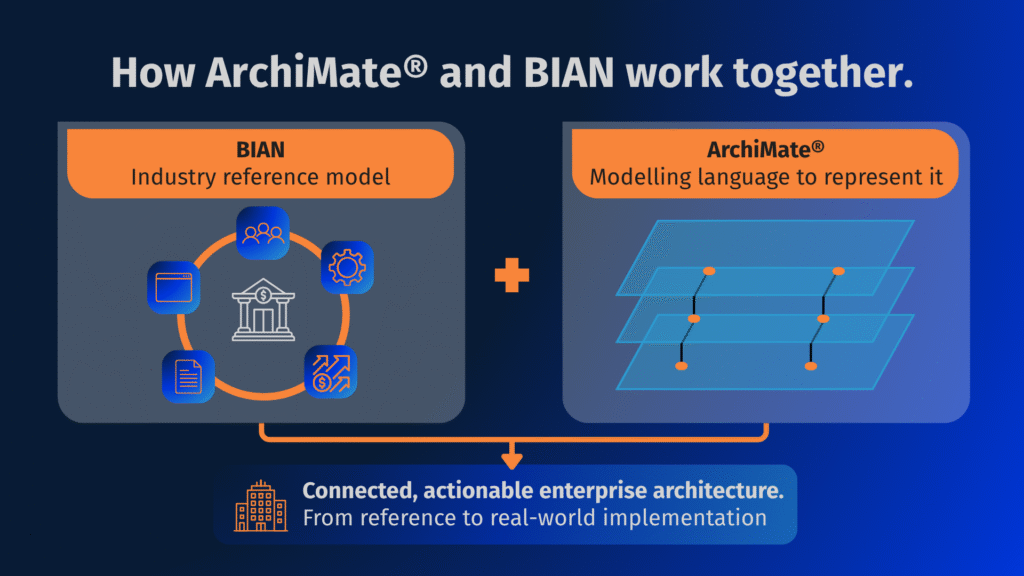
When used together, ArchiMate and BIAN enable banks to move from fragmented architecture to a connected, actionable model of the enterprise by helping to:
1. Align to a proven industry standard: Instead of building internal capability models from scratch, organisations can adopt BIAN’s industry-recognised framework.
2. Make complexity visible: ArchiMate allows BIAN’s service landscape to be visualised across business, data, application and technology domains.
3. Identify inefficiencies: Gaps, overlaps and redundancies become immediately visible when capabilities and systems are clearly mapped.
4. Strengthen business–IT alignment: Business capabilities defined in BIAN can be directly linked to the applications and infrastructure that support them.
5. Accelerate transformation: Clear, structured models reduce ambiguity and enable faster, more confident decision-making.
Why this is critical now.
Financial institutions are undergoing unprecedented change:
- Transition to API-driven and microservices-based architectures
- Integration with external ecosystems and partners
- Ongoing regulatory and compliance demands
- Pressure to modernise legacy systems while maintaining stability.
BIAN provides an industry reference architecture that can inform the target architecture.
ArchiMate enables organisations to understand, communicate and implement it effectively.
Without both, transformation initiatives risk becoming fragmented, inconsistent and difficult to scale.
Building the capability to deliver real outcomes.
Adopting ArchiMate is not just about learning a notation, it’s about building the capability to:
- Communicate architecture clearly across stakeholders
- Align strategy with execution
- Deliver large-scale transformation programmes with confidence
For professionals in banking and financial services, this capability is increasingly essential.
Take the next step.
EA Learning’s ArchiMate® training course is designed to help you:
- Master the global standard for enterprise architecture modelling
- Achieve ArchiMate – Foundation and Practitioner certification
- Apply ArchiMate in real-world financial services scenarios
- Work effectively with frameworks like TOGAF® and BIAN
- Deliver architecture that drives measurable business outcomes
Whether you are modernising legacy platforms, defining target architectures, or leading transformation programmes, ArchiMate provides the clarity and structure to succeed.
Explore EA Learning’s ArchiMate® 3 – Foundation and Practitioner training and start building architecture that works at enterprise scale.