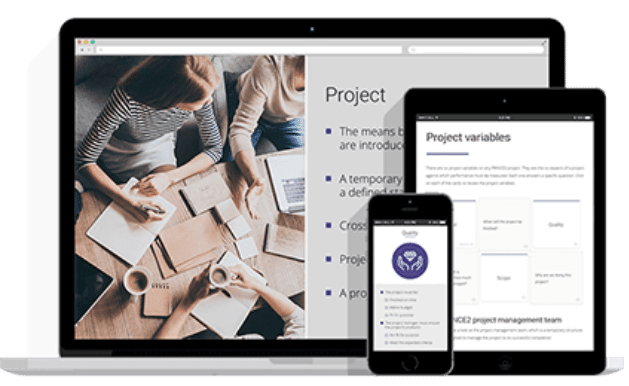
This comprehensive package combines the PRINCE2® 7 Foundation and Practitioner courses, offering a complete pathway to becoming fully certified in the globally recognised PRINCE2 project management method. PRINCE2 provides a structured, scalable, and adaptable approach to project management, distinguished by its rigorous focus on governance, risk management, and benefits realisation. By incorporating agile concepts and prioritising customisation, the updated PRINCE2 is exceptionally responsive to the varying demands of diverse project environments.
As trusted global partners in advancing organisational architecture capability, we help organisations train entire teams through flexible delivery options, volume discounts, and dedicated account management.
Partner with EA Learning to build the skills your organisation needs to drive successful transformation.
Our classes for this course are coming soon. Please use the join waitlist button to get notified.
As trusted global partners in advancing organisational architecture capability, we help organisations train entire teams through flexible delivery options, volume discounts, and dedicated account management.
We can provide guidance and help you choose an option to build the skills your organisation needs to drive successful transformation.
At EA Learning, we’re committed to supporting your team’s training needs and helping you maximise your budget. Here are a few ways we can assist:
This course is designed to be accessible to a wide range of professionals, from those aspiring to enter the field to experienced project managers seeking to update their skills. The content is delivered in simplified language to enhance understanding and application in real-world settings.
The PRINCE2® 7 Foundation & Practitioner course is provided by GEL, an ATO of PeopleCert.
PRINCE2® is a registered trademark of PeopleCert. Used under licence from PeopleCert. All rights reserved.


















































We specialise in partnering with organisations to build the confidence, competence and credibility needed to use architecture as a powerful enabler of business transformation through private training (classes held exclusively for your organisation) and regularly scheduled public classes.
Our specialist team takes the time to understand your organisation, covering your challenges, strategic priorities, capability gaps and where you are in your EA journey. From there, we prescribe training solutions that deliver meaningful, measurable outcomes.
Unlock significant savings as you scale training across your organisation, whether you register learners for public or private classes or a combination both.
For over 15 years, EA Learning has delivered The Open Group® accredited training courses to leading organisations to empower teams, build capability, drive transformation and achieve lasting impact.
We’ve worked with Fortune 500 tech companies, Big 4 consultancies, government agencies, major banks and IT companies.
EA Learning offers industry-leading training and certifications for enterprise, business and IT architects, and business transformation professionals.
Renowned for delivering consistently high quality learning experiences developed by industry experts, EA Learning has earned a strong reputation for excellence, with a 98% satisfaction rating across our courses.
Our expert instructors are industry leaders who bring extensive experience to every class, turning complex theory into practical, engaging learning.
Through rich anecdotes and industry-relevant examples, they deliver dynamic, impactful classes that build clarity and confidence, enabling you to immediately apply the skills you’ve developed.
Moving beyond passive learning, our eLearning courses feature engaging and interactive activities that reinforce key concepts, bringing them to life.
By integrating practical exercises and realistic case studies, we help to bridge the gap between abstract concepts and real-world implementation.
With instructors across the world, we offer virtual and in-person courses across various time zones to suit your schedule.
We specialise in working with organisations to create training packages, combining the potential to unlock huge savings with confidential, contextualised discussions reflect your organisational reality. Find out more.
PRINCE2® 7: Foundation
Module 0: Welcome to PRINCE2 7 Foundation
Module zero introduces you to the course main features, learning plan, aims and objectives, and structure. It also offers a diagram and tables pack, a glossary, and a course guide, which contains a syllabus, exam information, and some of the most frequently asked questions about PRINCE2 Foundation.
Module 1: Key concepts
Module 1 defines key concepts related to project management, including the integrated elements of PRINCE2, the definition of a project and project management, the aspects of project performance to be managed, and the definition of delivery approaches. The module also explains the common reasons why project management is used, common challenges that PRINCE2 is designed to address, the characteristics of a project, the project environment, and the features and benefits of PRINCE2.
Module 2: Principles
Module 2 describes the PRINCE2 principles: Ensure continued business justification, Learn from experience, Define roles, responsibilities and relationships, Manage by exception, Manage by stages, Focus on products, Tailor to suit the project. It also explains how and why the principles provide the basis of applying PRINCE2, which factors influence the way the PRINCE2 method can be tailored and applied, who’s responsible, and how tailoring decisions are documented.
Module 3: People
Module 3 focuses on the people element of PRINCE2, defining key concepts and the difference between people within the project and people affected by the project, and between leadership and management. It also explains the purpose of the management products required to support the people element of projects, and how people aspects integrate with other PRINCE2 elements.
Module 4: Introduction to PRINCE2 practices
Module 4 provides an overview of the PRINCE2 practices. It also explains the purpose of PRINCE2 management products, including the project initiation documentation (PID) and project log.
Module 5: The business case practice
Module 5 focuses on the business case practice. It starts by defining the key concepts related to the practice and explaining its purpose. It then provides guidance for effective management of the business case, including the business case lifecycle, aligning products to business objectives and tolerances, and establishing business justification. The module also describes the PRINCE2 technique for the business case practice, explains the purpose of the key management products required to support the practice, and describes the practice’s key relationships with the PRINCE2 principles.
Module 6: The organising practice
Module 6 focuses on the organizing practice. It starts by defining the key concepts related to the practice and explaining its purpose. It then provides guidance for effective organising of the three project interests, PRINCE2 roles, and work breakdown structure. The module also describes the PRINCE2 technique for the organising practice, explains the purpose of the key management products required to support the practice, and describes the practice’s key relationships with the PRINCE2 principles.
Module 7: The plans practice
Module 7 focuses on the plans practice. It starts by defining the key concepts related to the practice and explaining its purpose. It then provides guidance for effective management of plans, explaining the planning horizon, project stages, product-based planning, using tolerances to manage constraints, and delivery sustainability. The module also describes the PRINCE2 technique for the plans practice, explains the purpose of the key management products required to support the practice, and describes the practice’s key relationships with the PRINCE2 principles.
Module 8: The quality practice
Module 8 focuses on the quality practice. It starts by defining the key concepts related to the practice and explaining its purpose. It then provides guidance for effective management of quality, covering user quality expectations, acceptance criteria, quality specifications, and requirements. The module also describes the PRINCE2 technique for the quality practice, explains the purpose of the key management products required to support the practice, and describes the practice’s key relationships with the PRINCE2 principles.
Module 9: The risk practice
Module 9 focuses on the risk practice. It starts by defining the key concepts related to the practice and explaining its purpose. It then provides guidance for effective management of risk, covering risk planning, analysis, control and culture, along with decision bias, recommended risk response types, and use of data. The module also describes the PRINCE2 technique for the risk practice, explains the purpose of the key management products required to support the practice, and describes the practice’s key relationships with the PRINCE2 principles.
Module 10: The issues practice
Module 10 focuses on the issues practice. It starts by defining the key concepts related to the practice and explaining its purpose. It then provides guidance for effective management of issues, covering baselines, issue resolution, change control, delegating authority for changes, and the change budget. The module also describes the PRINCE2 technique for the issues practice, explains the purpose of the key management products required to support the practice, and describes the practice’s key relationships with the PRINCE2 principles.
Module 11: The progress practice
Module 11 focuses on the progress practice. It starts by defining the key concepts related to the practice and explaining its purpose. It then provides guidance for effective management of progress, covering tolerances for progress control, types of control reviewing and reporting progress and lessons, forecasting, escalating, and the use of data and systems in progress management. The module also describes the PRINCE2 technique for the progress practice, explains the purpose of the key management products required to support the practice, and describes the practice’s key relationships with the PRINCE2 principles.
Module 12: PRINCE2 processes
Module 12 explains the purpose, objectives, and context of the PRINCE2 processes:
Module 13: Practice exams
Module 13 contains two practice tests provided by PeopleCert
Module 14: PRINCE2 7 Foundation wrap-up
Module 14 provides information on booking the exam and other courses of interest.
PRINCE2® 7: Practitioner
Module 0: Welcome to PRINCE2 7 Practitioner
Module zero introduces you to the course main features, learning plan, aims and objectives, and structure.
It also offers a diagram and tables pack, a glossary, and a course guide, which contains a syllabus, exam information, and some of the most frequently asked questions about PRINCE2 Practitioner.
Module 1: The PRINCE2 Principles
Module 1 reviews the PRINCE2 Principles and presents a case study where learners can practice applying the principles to exam style questions.
Module 2: People Management in PRINCE2
Module 2 reviews the key concepts of people management in PRINCE2 Principles and presents a case study where learners can practice applying people management concepts to exam style questions.
Module 3: The business case practice
Module 3 begins by reviewing the key concepts of the business case from Foundation. It then explores techniques that support the practice before looking at how to effectively apply the business case. It finishes by presenting a case study where
Module 4: The organising practice
Module 4 begins by reviewing the key concepts of the organizing practice from Foundation. It then explores techniques that support the practice before looking at how to effectively apply the organising practice. It finishes by presenting a case study where learners can apply the organising practice to exam style questions.
Module 5: The plans practice
Module 5 begins by reviewing the key concepts of the plans practice from Foundation. It then explores techniques that support the practice before looking at how to effectively apply the plans practice. It finishes by presenting a case study where learners can apply the plans practice to exam style questions.
Module 6: The quality practice
Module 6 begins by reviewing the key concepts of the quality practice from Foundation. It then explores techniques that support the practice before looking at how to effectively apply the quality practice. It finishes by presenting a case study where learners can apply the quality practice to exam style questions.
Module 7: The risk practice
Module 7 begins by reviewing the key concepts of the risk practice from Foundation. It then explores techniques that support the practice before looking at how to effectively apply the risk practice. It finishes by presenting a case study where learners can apply the risk practice to exam style questions.
Module 8: The issues practice
Module 8 begins by reviewing the key concepts of the issues practice from Foundation. It then explores techniques that support the practice before looking at how to effectively apply the issues practice. It finishes by presenting a case study where learners can apply the issues practice to exam style questions.
Module 9: The progress practice
Module 9 begins by reviewing the key concepts of the progress practice from Foundation. It then explores techniques that support the practice before looking at how to effectively apply the progress practice. It finishes by presenting a case study where learners can apply the progress practice to exam style questions.
Module 10: The starting up a project process
Module 10 begins by reviewing the key concepts of the starting up a project process from Foundation. It then explores how to effectively apply the process and the relationship between the process and the PRINCE2 practices. It finishes by presenting a case study where learners can apply the process to exam style questions.
Module 11: The directing a project process
Module 11 begins by reviewing the key concepts of the directing a project process from Foundation. It then explores how to effectively apply the process and the relationship between the process and the PRINCE2 practices. It finishes by presenting a case study where learners can apply the process to exam style questions.
Module 12: The initiating a project process
Module 12 begins by reviewing the key concepts of the initiating a project process from Foundation. It then explores how to effectively apply the process and the relationship between the process and the PRINCE2 practices. It finishes by presenting a case study where learners can apply the process to exam style questions.
Module 13: The controlling a stage process
Module 13 begins by reviewing the key concepts of the controlling a stage process from Foundation. It then explores how to effectively apply the process and the relationship between the process and the PRINCE2 practices. It finishes by presenting a case study where learners can apply the process to exam style questions.
Module 14: The managing product delivery process
Module 14 begins by reviewing the key concepts of the managing product delivery process from Foundation. It then explores how to effectively apply the process and the relationship between the process and the PRINCE2 practices. It finishes by presenting a case study where learners can apply the process to exam style questions.
Module 15: The managing a stage boundary process
Module 15 begins by reviewing the key concepts of the managing a stage boundary process from Foundation. It then explores how to effectively apply the process and the relationship between the process and the PRINCE2 practices. It finishes by presenting a case study where learners can apply the process to exam style questions.
Module 16: The managing product delivery process
Module 16 begins by reviewing the key concepts of the closing a porject process from Foundation. It then explores how to effectively apply the process and the relationship between the process and the PRINCE2 practices. It finishes by presenting a case study where learners can apply the process to exam style questions.
Module 17: The Practice exams
Module 17 presents two practice exams, provided by PeopleCert.
You can take the PRINCE2 Foundation and Practitioner exams online through PeopleCert, a globally recognized exam institute.
This course provides numerous mock exams to ensure you are well-prepared for the official test.
Before scheduling your exam, please confirm that your device meets the necessary technical requirements. Consult the PeopleCert website for more information.
Voucher requests are usually processed within 2 working days, though we ask you to allow up to 5 days. Remember to request your exam voucher during the access period for the course, which begins from your purchase date.
After passing both exams, you’ll earn the PRINCE2 7 Foundation badge and the PRINCE2 7 Practitioner badge. You can proudly display these on your LinkedIn profile to showcase your achievement and expertise.
Prerequisites for PRINCE2® 7 Practitioner Exam
PRINCE2® 7 Foundation Exam
PRINCE2® 7 Practitioner Exam
PRINCE2 (Projects IN Controlled Environments) is a widely recognized project management methodology owned by PeopleCert. It is structured to provide project managers with the essential tools and insights needed to deliver projects efficiently within set timelines and budgets. Its comprehensive approach is designed to minimise risks while maximising project outcomes.
PRINCE2 is built on a foundation of controlled stages, clear roles and responsibilities, and a business case that justifies the project throughout its lifecycle. Each project under PRINCE2 follows a systematic approach with predefined processes that guide the project from initiation through to closure, ensuring consistent oversight and alignment with the project objectives.
Holding a PRINCE2 certification is highly regarded in the project management industry. Salary surveys, such as those from Payscale, show that PRINCE2-certified professionals can expect to earn between $53,000 and over $217,000 annually, depending on their role, experience, and geographical location. This certification opens doors to advanced project management roles and increases job prospects significantly.
Organisations implementing PRINCE2 can expect enhanced project management efficiency, including:
PRINCE2 is versatile, suitable for anyone involved in project management, regardless of industry sector. It benefits both new and experienced project managers by providing a rigorous, process-driven approach to project management that is replicable in various project environments.
The pathway starts with the PRINCE2 Foundation, progressing to the PRINCE2 Practitioner. For those interested in combining agile methodologies with traditional project management, the PRINCE2 Agile® tracks are available, which can complement or serve as an alternative pathway.
PRINCE2 works well alongside other management frameworks like MSP® (for programme management) and ITIL® 4 (for IT service management), offering a robust suite of governance across various organisational functions.
PRINCE2 qualifications are valid for three years, with the option to extend or reactivate by taking another PeopleCert-accredited exam.
Take the first step to certification by registering yourself or your organisation for an upcoming public class.
Get in touch with one of our experts to find out more about the course and learn how we can meet your organisation’s requirements.
We’re excited to announce an upcoming course that’s just around the corner! Register your interest by completing the form below, and you’ll be amongst the first to receive updates and exclusive details about the course. One of our team members will be in touch soon!
At EA Learning, we support organisations to plan and deliver effective training while making the most of their training budgets. We can assist in a number of ways, including:
Please complete the form below and a member of our specialist team will be in touch shortly to discuss your requirements and recommend suitable options. We look forward to supporting your team’s development.