Book a Free 15-Minute Call
Team Member Profile
EA Learning Team
We can help identify a learning pathway designed to achieve the strongest outcomes in the areas where you need it most.

The power skills AI can’t replace. Explore our two latest workshops: ArchiEQ: Unlocking Your Potential and ArchiEQ: Influence with Impact.

Agile Business Analyst (AgileBA®) Foundation & Practitioner

Drawing from the AgileBA® Handbook by the Agile Business Consortium, this course is perfectly suited for those looking to comprehend the role of a business analyst within Agile environments. Students will discover how Agile business analysts deliver substantial value across various organisational aspects.

30+ Hours - 12 Months Access
Self-paced eLearning
Fully Accredited
12 Month Access
Agile Business Analyst (AgileBA®) Foundation & Practitioner - eLearning

Individual Access

Complete online at your own pace
$1,359.00
Before applicable taxes

Partner with EA Learning to build capability at scale.

As trusted global partners in advancing organisational architecture capability, we help organisations train entire teams through flexible delivery options, volume discounts, and dedicated account management.

Partner with EA Learning to build the skills your organisation needs to drive successful transformation.

Course Waitlist

Our classes for this course are coming soon. Please use the join waitlist button to get notified.

Partner with EA Learning to build capability at scale.

As trusted global partners in advancing organisational architecture capability, we help organisations train entire teams through flexible delivery options, volume discounts, and dedicated account management.

We can provide guidance and help you choose an option to build the skills your organisation needs to drive successful transformation.

Discounted Training for Teams and Organisations

At EA Learning, we’re committed to supporting your team’s training needs and helping you maximise your budget. Here are a few ways we can assist:

  • Arrange a private course exclusively for your team with group pricing.
  • Save on training costs with exclusive bulk pricing discounts when you prepay for multiple courses or places on classes.
  • Get special discounted pricing when you prepay at a tiered level, allowing you to draw down on your balance for any course. Ideal for organisations looking to maximise their training budgets and invest in ongoing professional development.

Course Overview

Key Features

  • Exam vouchers included
  • Course duration: 30+ hours
  • Access Period: 12 months
  • Tutor support
  • Quizzes and exam practice
  • Works on mobile devices
  • Provider: GEL
  • Accredited by: APMG International

Additionally, this course comprehensively prepares students to successfully complete the Agile Business Analyst (AgileBA) Foundation & Practitioner certification exams.

This course encompasses the full AgileBA Foundation syllabus and provides all the resources necessary to pass the AgileBA Foundation exam.

However, the course does not include the AgileBA Core Manual, which is available for purchase at the APMG Bookstore.

Why take this course?

  • Agile methodologies and business analysis are highly valued practices in the business sector today.
  • AgileBA represents a rewarding specialisation avenue for both business analysts and Agile practitioners, promoting career growth.
  • The framework of AgileBA fosters continuous improvement and enhances communication across teams.
  • The course includes a rich array of online training materials, such as instructor-led videos, periodic knowledge checks, mock exams, and real-world case studies.
  • Good e-Learning, an award-winning provider of online courses, delivers this comprehensive training.
  • Each student is provided with 12 months of access and FREE exam vouchers, subject to terms and conditions.
  • This AgileBA® Foundation and Practitioner course is accredited by APMG International.

Target Audience

  • Practicing business analysts aiming to deepen their understanding of Agile methodologies.
  • Agile team members aspiring to transition into roles as Agile business analysts.
  • Managers and product owners looking to implement AgileBA’s best practices within their teams.
  • Individuals pursuing the AgileBA Foundation & Practitioner certifications to enhance their professional qualifications.

The courses on this page are offered by GEL, an Accredited Training Organisation of The APMG Group Ltd.

AgileBA® is a registered trademark of Agile Business Consortium Ltd. All rights reserved.

EA Learning is Trusted by Leading Organisations Globally

KPMG
Capgemini
NSW Community & Justice
Commonwealth Bank
CityOfGoldcoast
HCF
Westpac
NSW Police
Charter Hall
Brisbane Airport
Hydro Tasmania
Albury City
AMP
Australian Retirement Trust
Tas Government
Data3
Fujitsu
NTT
SAP
Just Web Ops
CIOco
Accenture
ACT Government
Munro Footwear Group
QUT
Queensland Government Health
Standard Process
Suncorp
Swinburne
VLine
TAC
Parks VIC
DOH
ACQ
Aurora
UNSW
SydWater
RBA
NDIA
McGrath
UWA
Club Marine
BSP
WA Housing
WesternPower
WyndhamCity
MainRoadsWA
URA
CAA
Salesforce

Learning Outcomes

  1. Comprehensive exploration of AgileBA principles, philosophy, and processes, and their practical application.
  2. Detailed methods for employing the AgileBA approach to manage requirements effectively.
  3. Utilisation of Agile techniques including Timeboxing, MoSCoW Prioritisation, and iterative targeting.
  4. Techniques for creating and assessing Business Analysis (BA) products within Agile projects.
  5. Strategies for managing and prioritising requirements in Agile environments.
  6. Understanding the levels of empowerment essential for defining the requirements of a Business Case.
  7. Examination of typical roles and requirements within Agile projects.
  8. Effective management of support and facilitation in Agile environments.
  9. Methods for testing, emulating, and evaluating the delivery of benefits in Agile projects.
  10. Development of actionable practices that translate the principles and philosophy of AgileBA into tangible business value.
  11. All-encompassing preparation needed to pass the official Agile Business Analyst (AgileBA®) Foundation & Practitioner exams.

Team and Enterprise Training

We specialise in partnering with organisations to build the confidence, competence and credibility needed to use architecture as a powerful enabler of business transformation through private training (classes held exclusively for your organisation) and regularly scheduled public classes.

Packages designed for your organisation.

Our specialist team takes the time to understand your organisation, covering your challenges, strategic priorities, capability gaps and where you are in your EA journey. From there, we prescribe training solutions that deliver meaningful, measurable outcomes.

Contextualised private classes.

Beyond standard team training, our private classes feature contextualised discussions in a confidential setting, with a pre-class consultation to align on your organisation’s goals, challenges and projects, ensuring discussions and examples are relevant.

Huge potential to unlock savings.

Unlock significant savings as you scale training across your organisation, whether you register learners for public or private classes or a combination both.

Why EA Learning?

Trusted by leading organisations globally.

For over 15 years, EA Learning has delivered The Open Group® accredited training courses to leading organisations to empower teams, build capability, drive transformation and achieve lasting impact.

We’ve worked with Fortune 500 tech companies, Big 4 consultancies, government agencies, major banks and IT companies.

We’re specialists, not generalists.

EA Learning offers industry-leading training and certifications for enterprise, business and IT architects, and business transformation professionals.

Renowned for delivering consistently high quality learning experiences developed by industry experts, EA Learning has earned a strong reputation for excellence, with a 98% satisfaction rating across our courses.

World-class instructors with real-world experience.

Our expert instructors are industry leaders who bring extensive experience to every class, turning complex theory into practical, engaging learning.

Through rich anecdotes and industry-relevant examples, they deliver dynamic, impactful classes that build clarity and confidence, enabling you to immediately apply the skills you’ve developed.

Beyond theory with immersive eLearning

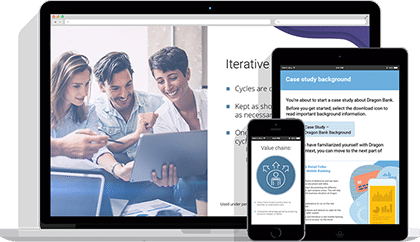
Moving beyond passive learning, our eLearning courses feature engaging and interactive activities that reinforce key concepts, bringing them to life.

By integrating practical exercises and realistic case studies, we help to bridge the gap between abstract concepts and real-world implementation.

Private and public classes worldwide.

With instructors across the world, we offer virtual and in-person courses across various time zones to suit your schedule.

We specialise in working with organisations to create training packages, combining the potential to unlock huge savings with confidential, contextualised discussions reflect your organisational reality. Find out more.

Syllabus

AgileBA® Foundation

An Introduction to this AgileBA Foundation Course
Module zero introduces you to the course’s main features, as well as the learning plan, aims, objectives, and structure.

It also offers a syllabus, diagram pack, glossary, further reading and links document, white papers, and links to download essential digital copies of the framework publications. It also contains some of the most frequently asked questions about the AgileBA qualification.

Foundation Module 1: The Role of the Business Analyst
In module one, we take a look at the role of the business analyst and how an AgileBA works in a very different way. We explore the context of an AgileBA’s role in relation to business needs and address some of the best practice techniques that can help an AgileBA support their organisation in the formulation of its strategies.

Foundation Module 2: Agile Fundamental Concepts: DSDM Principles & Roles
In module two, we consider the DSDM philosophy, along with the Agile approach to project variables. We address the DSDM process and how it can be scaled and configured. We then present the 8 DSDM principles along with the team model before considering the DSDM roles and how they work together.

Foundation Module 3: Agile Fundamental Concepts: DSDM Management Products
In this module, we explore the management products from each DSDM phase and the purpose that each of them serves. We also consider the role of the AgileBA within an Agile project.

Foundation Module 4: The Agile Business Case
In module four, we consider the role of the Agile business case, why you might need one, its connection to business strategy, and the typical contents. We discuss the Agile roles and responsibilities with regards to the business case and the Agile practices that can be leveraged in order to create one.

Foundation Module 5: Stakeholders in the Agile Project
In module five, we look at how to work with stakeholders in an Agile project. We start off by understanding what a stakeholder is and how to engage them through various techniques and practices. We explore what good communication looks like and how important it can be to engage stakeholders at the right time with the right level of detail. We also examine the impact this can have on the project outcomes.

Foundation Module 6: Agile Practices: Facilitated Workshops
Utilising facilitated workshops is a proven Agile practice that ensures robust collaboration, rich communication, and the achievement of results with speed and buy-in. In this module, we’ll explore some of the more common types of facilitated workshops and how the AgileBA is involved in their use throughout a DSDM project.

Foundation Module 7: Agile Practices Modeling
In module seven, we continue our journey exploring key Agile practices. We start off by considering modeling and prototyping. You’ll understand the target audience for these practices and why they are so useful. We’ll discuss the different types of modeling and their purposes before looking at the link this practice has with the DSDM principles.

Foundation Module 8: Prioritisation
Module 8 looks at prioritisation and the key role it plays within Agile projects. We’ll discuss different prioritisation tools like MoSCoW and the Kano model, and the role that effective prioritisation has in the success of a project.

Foundation Module 9: Agile Practices: Timeboxes & Iterative Development
This module is concerned with timeboxes, what these are and what they are used for within a project. We then move on to explore iterative development and the function it has in solution development and testing. We’ll conclude by exploring how AgileBAs are involved with both elements in an Agile project.

Foundation Module 10: Requirements Introduction
Modules 10 and 11 introduce you to requirements, their planning, and how to estimate them. Module 10 starts off by explaining several definitions and then moves on to dissect how requirements activities develop throughout the DSDM lifecycle. You’ll be introduced to user stories during the module, as well as the INVEST model, and you’ll also get to grips with the purpose of the PRL.

Foundation Module 11: Requirements Planning & Estimating
In this module, we continue to explore requirements and the function they have within Agile projects. Here you are introduced to the concept of requirements planning and estimating within DSDM. We cover the estimating process and the role the AgileBA has in relation to requirements.

Foundation Module 12: Making the Transition
The final module is a brief interview conducted with our subject matter expert and course instructor, Antony della Porter. Antony considers several questions around the need for change and how this applies specifically to the role of the AgileBA.

Practice Exam Simulators
The course features two practice papers for the AgileBA Foundation examination. One is provided by APMG, while the other comes from the Good e-Learning team. Students are encouraged to fully familiarise themselves with the course modules before attempting the practice exams.

AgileBA® Practitioner

An Introduction to this AgileBA Practitioner Course

This module introduces the main features of the course, as well as the leaning plan, objectives, aims, and structure.

It also offers a syllabus, diagram pack, glossary, further reading and links document, white papers, and links to download essential digital copies of the AgileBA framework’s publications. Finally, it covers some of the most frequently asked questions regarding AgileBA.

Practitioner Module 1: Business Analysis Fundamentals

This module starts with a quiz that reviews the content of AgileBA Foundation.

It then introduces an interactive case study (that includes a company background and project background, as well as project objectives), that will help learners study how to apply business analysis techniques appropriately within a given context. Students will also learn to evaluate whether a technique has been correctly applied.

Practitioner Module 2: Stakeholder Analysis & Engagement

This module starts with a quiz that reviews the content of AgileBA Foundation.

It then presents an interactive case study containing information that students will use, along with what they have already learned, to construct a lean canvas and engage stakeholders.

Practitioner Module 3: Customer Journeys & Personas

This module starts with a quiz that reviews the content of AgileBA Foundation.

It then presents an interactive case study that learners will use to model a customer journey and construct a stakeholder persona.

Practitioner Module 4: Facilitated Workshops & Modeling

This module starts with a quiz that reviews the content of AgileBA Foundation.

It then presents an interactive case study that learners will use to apply their knowledge of Agile practices. Learners will also be asked to evaluate whether the company described in the scenario has used appropriate models and prototypes in its project.

Practitioner Module 5: Timeboxing & Iterative Development

This module starts with a quiz that reviews the content of AgileBA Foundation.

It then presents an interactive case study that learners will use to apply their knowledge of timeboxing and iterative development. Learners will then assess whether the same practices were deployed appropriately and effectively in the context of the case study.

Practitioner Module 6: Prioritisation & Testing

This module starts with a quiz that reviews the content of AgileBA Foundation.

It then presents an interactive case study that learners will use to apply their knowledge of prioritisation within a project lifecycle. Learners will also utilise testing criteria and develop their own acceptance criteria before evaluating the same processes used in the case study.

Practitioner Module 7: User Stories

This module starts with a quiz that reviews the content of AgileBA Foundation.

It then presents an interactive case study that learners will use to apply their knowledge of user stories. Learners will also assess whether the same practice has been used effectively within the case study.

Practice Exam Simulators

The course features two practice papers for the AgileBA Practitioner examination. One is provided by APMG, while the other comes from the Good e-Learning team. Students are encouraged to fully familiarise themselves with the course modules before attempting the practice exams.

Exams

This course is specifically tailored to prepare students for the AgileBA Foundation and Practitioner exams, enabling them to complete both certifications in quick succession.

Receiving your voucher: Exam vouchers for any APMG-accredited course can be requested at any time after you have started your course. Exam vouchers for any APMG-accredited course can be requested at any time after you have started your course. Voucher requests are generally processed within two working days, though we ask you to allow up to five. Be sure to request your exam voucher within the access period of the course.

Taking your exam: Exams for GEL’s APMG courses can only be taken online. APMG’s exams are managed through the ProctorU service. To take an exam via ProctorU, candidates will need to download the Guardian Browser. Installing this browser may require local administrator permission. 

Prior to scheduling your exam, ensure your device meets the necessary technical specifications, as AgileBA exams are proctored online by ProctorU on behalf of APMG International. Please visit the APMG International website for more information.

Rescheduling your exam: APMG allows candidates to reschedule their exam once with no additional cost. You must reschedule the exam at least 10 days before the original exam date. APMG charge an administration fee to reschedule an exam a second time. 

Extending exam voucher validity: APMG exam vouchers cannot be extended beyond the validity period shown on the voucher. 

Exam retakes: APMG doesn’t offer an exam retake program. If you would like to retake an APMG exam, you must purchase a new exam voucher. 

Digital Credentials:

After passing both exams, you’ll earn the AgileBA Foundation Badge and the AgileBA Practitioner Badge. You can proudly display these on your LinkedIn profile to showcase your achievement and expertise.


AgileBA® Foundation exam

  • This is a multiple choice exam consisting of 50 questions
  • There is a time limit of 40 minutes to complete the exam
  • The exam is closed book, with only the provided materials being permitted for use
  • The pass mark for the exam is 50%: you must get 25 out of 50 questions correct

AgileBA® Practitioner exam

  • This is a complex multiple-choice exam
  • There are four questions per paper
  • Each question offers 20 marks
  • To pass, candidates must score at least 50% (40 marks out of 80)
  • The exam lasts 2.5 hours (150 minutes)
  • The exam is open-book (AgileBA Handbook only)

FAQs

What is AgileBA?

‘Agile Business Analyst (AgileBA)’ is a qualification created by APMG International. It is designed to demonstrate and explain how business analysts operate and create value within Agile projects and environments.

How does AgileBA work?

AgileBA combines the traditional role of a business analyst with the tools, best practices, and environmental factors of Agile projects. Candidates study how the two elements enhance one another, driving continuous improvement within both projects and the wider business.

What is a business analyst?

A ‘business analyst’ is a versatile professional who analyses and advises on various aspects of a typical business, including project management, communication, and data analysis. They will look through documents, processes, business models, systems, technological integration, and more, developing a keen understanding of how everything works while also consulting experts and stakeholders. This helps them to identify potential areas for improvement.

What does the AgileBA certification path look like?

To become fully certified in AgileBA, learners will start by studying for the AgileBA Foundation certification exam. Passing this stage will qualify them to sit the AgileBA Practitioner certification exam.

Candidates who wish to further develop their knowledge of Agile may also choose to study AgilePM at Foundation and Practitioner level. Both AgileBA and AgilePM were developed by the APMG.

How can AgileBA benefit my business?

An AgileBA practitioner will be able to continuously search out and highlight opportunities to improve your business, not just for Agile projects but also in other areas such as communications and data analysis. This will help you to enhance operations across the board.

What do I need to study AgileBA?

There are no prerequisites for studying AgileBA at Foundation level. However, having at least some background knowledge of either Agile or business analysis can be helpful.

In order to sit the AgileBA Practitioner exam, a candidate must first earn their Foundation qualification.

Who can benefit from studying AgileBA?

As a topic, AgileBA has a lot of potential value for both experienced and prospective business analysts. This is particularly evident when we consider the expanding global popularity of Agile.

It can also benefit Agile project managers who wish to develop an understanding of business analysis, as well as organisations looking to adopt the framework’s tools and best practices.

In what industries is AgileBA popular?

Both business analysis and Agile are popular in a wide variety of industries and sectors across the world. Both offer widely-applicable best practices and benefits, especially in terms of managing projects successfully and driving continuous improvement. As a result, AgileBA practitioners can often enjoy significant career and networking opportunities.

Ready to secure your spot?

Take the first step to certification by registering yourself or your organisation for an upcoming public class.

Related Courses

Pricing in USD

Speak with a specialist.

Get in touch with one of our experts to find out more about the course and learn how we can meet your organisation’s requirements.