The power skills AI can’t replace. Explore our two latest workshops: ArchiEQ: Unlocking Your Potential and ArchiEQ: Influence with Impact.
As trusted global partners in advancing organisational architecture capability, we help organisations train entire teams through flexible delivery options, volume discounts, and dedicated account management.
Partner with EA Learning to build the skills your organisation needs to drive successful transformation.
Our classes for this course are coming soon. Please use the join waitlist button to get notified.
As trusted global partners in advancing organisational architecture capability, we help organisations train entire teams through flexible delivery options, volume discounts, and dedicated account management.
We can provide guidance and help you choose an option to build the skills your organisation needs to drive successful transformation.
At EA Learning, we’re committed to supporting your team’s training needs and helping you maximise your budget. Here are a few ways we can assist:
In today’s digital era, the skills of IT Service Management (ITSM) teams are crucial for achieving sustainability goals. ITSM managers often take the lead in enhancing their team’s abilities to tackle present and forthcoming sustainability challenges, particularly in procurement and supply chain management. This ITIL® 4 course offers proven and adaptable strategies for empowering businesses to promote sustainability within their digital and IT operations.
This course, focusing on ITIL® 4 Specialist: Sustainability in Digital & IT, does not require previous ITIL certifications, allowing candidates to sit for the ITIL 4 Sustainability in Digital and IT exam without needing to pass the ITIL 4 Foundation exam first. It introduces key ITIL 4 concepts, equipping candidates to effectively contribute to ITIL teams, even if they do not seek further certification.
The ITIL® 4 Specialist: Sustainability in Digital & IT course is provided by GEL, an ATO of PeopleCert.
ITIL® is a registered trademark of PeopleCert. Used under licence from PeopleCert. All rights reserved.
We specialise in partnering with organisations to build the confidence, competence and credibility needed to use architecture as a powerful enabler of business transformation through private training (classes held exclusively for your organisation) and regularly scheduled public classes.
Our specialist team takes the time to understand your organisation, covering your challenges, strategic priorities, capability gaps and where you are in your EA journey. From there, we prescribe training solutions that deliver meaningful, measurable outcomes.
Unlock significant savings as you scale training across your organisation, whether you register learners for public or private classes or a combination both.
For over 15 years, EA Learning has delivered The Open Group® accredited training courses to leading organisations to empower teams, build capability, drive transformation and achieve lasting impact.
We’ve worked with Fortune 500 tech companies, Big 4 consultancies, government agencies, major banks and IT companies.
EA Learning offers industry-leading training and certifications for enterprise, business and IT architects, and business transformation professionals.
Renowned for delivering consistently high quality learning experiences developed by industry experts, EA Learning has earned a strong reputation for excellence, with a 98% satisfaction rating across our courses.
Our expert instructors are industry leaders who bring extensive experience to every class, turning complex theory into practical, engaging learning.
Through rich anecdotes and industry-relevant examples, they deliver dynamic, impactful classes that build clarity and confidence, enabling you to immediately apply the skills you’ve developed.
Moving beyond passive learning, our eLearning courses feature engaging and interactive activities that reinforce key concepts, bringing them to life.
By integrating practical exercises and realistic case studies, we help to bridge the gap between abstract concepts and real-world implementation.
With instructors across the world, we offer virtual and in-person courses across various time zones to suit your schedule.
We specialise in working with organisations to create training packages, combining the potential to unlock huge savings with confidential, contextualised discussions reflect your organisational reality. Find out more.
ITIL® 4 Specialist: Sustainability in Digital & IT (SDIT)
Welcome to ITIL® 4 Specialist: Sustainability in Digital & IT
This introductory module highlights the main features of the course, including the learning plan, structure, aims, and objectives. It revisits essential elements from the ITIL 4 Foundation and outlines the written assignments integral to the course structure. Candidates also receive a comprehensive syllabus, diagram pack, glossary, and further reading materials, along with links to download key framework publications. The module wraps up by addressing frequently asked questions.
Module 1: Key Concepts
The first part of this module introduces fundamental sustainability concepts.
Chapter 2 explores the UN Sustainable Development Goals (SDGs) and their role in organisational sustainability.
Chapter 3 discusses the Triple Bottom Line (TBL) model, Corporate Social Responsibility (CSR), and the business benefits of sustainability.
Module 2: What is the vision?
Chapter 1 introduces the essential vocabulary and objectives that will guide the understanding and discussions throughout the module. It sets the groundwork for exploring the depth of sustainability visions.
Chapter 2 focuses on the importance of having a clearly defined sustainability vision. It discusses how this vision can guide organisational strategies and decision-making processes to integrate sustainability effectively.
Chapter 3 explores various sustainability models and frameworks that organisations can adopt. This chapter examines current sustainability issues and discusses potential solutions, providing a comprehensive overview of the environmental, social, and economic aspects involved.
Chapter 4 shifts focus to how digital technologies influence sustainability efforts. It covers both the opportunities and challenges that digital solutions bring to achieving sustainability goals, highlighting innovative practices that enhance environmental stewardship.
Chapter 5 introduces the first of four compulsory written assignments that allow candidates to apply their knowledge practically.
Module 3: Where are we now?
This module begins by assessing the current state of organisational sustainability. Chapter 1 also explains the module’s core terminology and objectives.
Chapter 2 details assessments like materiality and sustainability risk, along with stakeholder mapping.
Chapter 3 reviews regulations, standards, and internal assessment perspectives.
Module 4: Where do we want to be?
This module focuses on setting the future targets for sustainability efforts. Chapter 1 explains the module’s core terminology and objectives.
Chapter 2 uses a case study to discuss strategic sustainability planning.
Chapter 3 focuses on setting and prioritising sustainability objectives.
Chapter 4 introduces the second written assignment.
Module 5: Review Modules 1-4
A review of the initial modules through interactive games and concept checks.
Module 6: How do we get there?
This module addresses the development of strategies to achieve set sustainability goals. Chapter 1 explains the module’s core terminology and objectives.
Chapter 2 examines the most important sustainable business models and how they can be supported.
Chapter 3 looks at how IT and digital technology support sustainable models and cultures.
Chapter 4 introduces the third written assignment.
Module 7: Take action
Chapter 1 provides an overview of the ‘Take action’ step of the sustainability journey.
Chapter 2 describes actionable steps towards sustainability in a VUCA environment (Volatility, Uncertainty, Complexity, Ambiguity), along with use of the Cynefin model and sense-making.
Chapter 3 discusses how ITIL management practices integrate with sustainability efforts.
Module 8: Did we get there?
Chapter 1 explains the module’s core terminology and objectives.
Chapter 2 discusses how to evaluate the effectiveness of the sustainability strategies implemented.
Chapter 3 introduces the final written assignment.
Module 9: How do we keep the momentum going?
Chapter 1 explains the module’s core terminology and objectives.
Chapter 2 focuses on ensuring long-term commitment to sustainability through governance and innovation.
Module 10: Review Modules 6-9
A final review through games and checks to ensure a solid understanding of the later modules.
Module 11: Practice exams
Offers practice exams provided by PeopleCert and Good e-Learning to prepare candidates for the official certification exam.
Module 12: wrap-up
Concludes with a video summarising the course and outlining next steps for the candidates.
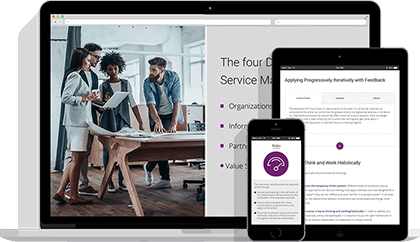
This course is designed to prepare students to sit and pass the ITIL® 4 Specialist: Sustainability in Digital & IT examination.
This course comes with a FREE exam voucher – That’s how confident we are that you’ll pass first time!
PeopleCert Exam Information
Your exam voucher will be sent to you shortly after you purchase your course. The exam voucher must be redeemed on the PeopleCert website before starting your course. Redeeming the exam voucher allows customers to access the official eBook.
PeopleCert exams can be taken online, through your web browser or using ExamShield proctoring software. Candidates choose how to take their exam in their account area on the PeopleCert website.
PeopleCert operate an exam insurance scheme called Take2. If you would like the opportunity to retake the exam , you must purchase Take2 before taking your exam.
Take2 can be purchased through your PeopleCert account up to 15 minutes before your exam.
Alternatively, you can become a PeopleCert Plus member to receive a free resit for all certifications you take.
You can find detailed information on PeopleCert exam terms and conditions on our exams terms and conditions page.
After passing the exam, you’ll earn the ITIL® 4 Specialist: Sustainability in Digital & IT (SDIT) Badge, which you can proudly display on your LinkedIn profile to showcase your achievement and expertise.
ITIL® 4 Specialist: Sustainability in Digital & IT (SDIT) Assessment 1: Case Study Assignments
ITIL® 4 Specialist: Sustainability in Digital & IT (SDIT) Assessment 2: Multiple-Choice Questions (MCQ)
ITSM, or IT Service Management, involves applying policies, procedures, and best practices to optimise IT services for both clients and employees, enhancing efficiency and satisfaction.
ITIL 4 represents the latest evolution of ITIL, the globally recognised framework for ITSM. It provides a comprehensive set of best practices that guide IT-powered organisations in designing, developing, and continuously improving their IT services.
Originally, ITIL stood for ‘Information Technology Infrastructure Library.’ However, as the framework has evolved with frequent updates, it is no longer considered a static ‘library.’ Currently, ITIL doesn’t stand for anything but continues to be a leading model for IT service optimisation.
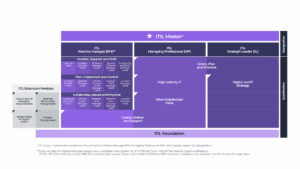
The ITIL certification journey begins with the ‘ITIL Foundation’. After achieving this, individuals can advance through ‘Practice Manager,’ ‘Managing Professional,’ or ‘Strategic Leader’ streams. Mastery of all streams enables one to qualify as an ‘ITIL Master.’ Additionally, there are four ITIL extension modules for those focusing on specific ITSM areas, which are not part of the main ITIL pathway.

ITIL certification can significantly enhance a professional’s earning potential. According to Payscale, certified ITIL practitioners can earn between $51,000 and over $259,000 annually, varying by experience, role, and certification level.
ITIL equips users with best practices for developing efficient IT services, fostering a culture of continuous improvement. This ensures services remain aligned with business objectives, optimises resources, and facilitates ongoing enhancements.
ITIL 4 helps organisations optimise IT practices, supports continuous quality improvement, and remains adaptable to integrate with other methodologies like DevOps. Its forward-looking approach ensures it remains relevant as technological and best practice standards evolve.
PeopleCert is a prominent accrediting body that owns and oversees several best practice frameworks, including ITIL 4, PRINCE2, MSP, PRINCE2 Agile, and AgileSHIFT.
ITIL 4 seamlessly integrates with other frameworks such as Agile, DevOps, Lean, and PRINCE2, enhancing its adaptability and applicability across various organisational contexts.
Take the first step to certification by registering yourself or your organisation for an upcoming public class.
Get in touch with one of our experts to find out more about the course and learn how we can meet your organisation’s requirements.
We’re excited to announce an upcoming course that’s just around the corner! Register your interest by completing the form below, and you’ll be amongst the first to receive updates and exclusive details about the course. One of our team members will be in touch soon!
At EA Learning, we support organisations to plan and deliver effective training while making the most of their training budgets. We can assist in a number of ways, including:
Please complete the form below and a member of our specialist team will be in touch shortly to discuss your requirements and recommend suitable options. We look forward to supporting your team’s development.