Build a practical foundation in operating model design and transformation using the OMDDMS® Standard. Through expert-led learning, real-world examples and hands-on exercises, gain the knowledge and confidence to assess, improve and communicate operating model change that supports strategy and performance.

| September | October | November | December | January | February | March | April | May | June | July | August |
|---|---|---|---|---|---|---|---|---|---|---|---|
|
On Sale - SAVE 10%
$2,190.00
$1,971.00
Before applicable taxes
On Sale - SAVE 10%
$2,190.00
$1,971.00
Before applicable taxes
-
|
Mon 05 - Tue 06 Oct
9am-5pm CDT
On Sale - SAVE 10%
$2,190.00
$1,971.00
Before applicable taxes
On Sale - SAVE 10%
$2,190.00
$1,971.00
Before applicable taxes
-
|
$2,190.00
Before applicable taxes
-
|
$2,190.00
Before applicable taxes
$2,190.00
Before applicable taxes
$2,190.00
Before applicable taxes
$2,190.00
Before applicable taxes
-
|
-
|
-
|
-
|
-
|
-
|
-
|
-
|
-
|
As trusted global partners in advancing organisational architecture capability, we help organisations train entire teams through flexible delivery options, volume discounts, and dedicated account management.
Partner with EA Learning to build the skills your organisation needs to drive successful transformation.
Our classes for this course are coming soon. Please use the join waitlist button to get notified.
To attend public Virtual Classrooms.
Any date and timezone in the next 6 months.
Save 20% off the RRP
For us to hold an exclusive private Virtual Classroom class for your organisation.
Includes pre-class meeting with instructor, contextualised conversations during the class and post-class debrief.
Held over consecutive dates in the next 6 months - subject to instructor availability.
Save 20% off the RRP
As trusted global partners in advancing organisational architecture capability, we help organisations train entire teams through flexible delivery options, volume discounts, and dedicated account management.
We can provide guidance and help you choose an option to build the skills your organisation needs to drive successful transformation.
Uplift your team’s capability through exclusive, in-house classes that embed your unique organisational context into class discussions, all while unlocking significant cost savings as you scale your training.
Gain a practical understanding of operating model design and transformation with EA Learning’s accredited Applied Operating Models: Design and Delivery – Foundation course.
Based on the OMDDMS® Standard, this two-day course introduces a common language, proven concepts and structured approach for understanding, assessing and improving operating models.
Through expert-led instruction, interactive discussions, practical exercises and real-world examples, you will explore the key components of an operating model, how they work together and the role they play in delivering strategy and organisational performance.
You will also learn how to identify common operating model challenges, assess their impacts, understand transformation requirements and communicate opportunities for improvement with greater clarity, consistency and stakeholder alignment.
By the end of the course, you will have a solid foundation in operating model thinking, a clear understanding of the OMDDMS® framework and the confidence to contribute more effectively to operating model transformation initiatives, strategic change programmes and organisational improvement efforts while helping drive sustainable business performance and long-term value creation.






























We specialise in partnering with organisations to build the confidence, competence and credibility needed to use architecture as a powerful enabler of business transformation through private training (classes held exclusively for your organisation) and regularly scheduled public classes.
Our specialist team takes the time to understand your organisation, covering your challenges, strategic priorities, capability gaps and where you are in your EA journey. From there, we prescribe training solutions that deliver meaningful, measurable outcomes.
Unlock significant savings as you scale training across your organisation, whether you register learners for public or private classes or a combination both.
For over 15 years, EA Learning has delivered The Open Group® accredited training courses to leading organisations to empower teams, build capability, drive transformation and achieve lasting impact.
We’ve worked with Fortune 500 tech companies, Big 4 consultancies, government agencies, major banks and IT companies.
EA Learning offers industry-leading training and certifications for enterprise, business and IT architects, and business transformation professionals.
Renowned for delivering consistently high quality learning experiences developed by industry experts, EA Learning has earned a strong reputation for excellence, with a 98% satisfaction rating across our courses.
Our expert instructors are industry leaders who bring extensive experience to every class, turning complex theory into practical, engaging learning.
Through rich anecdotes and industry-relevant examples, they deliver dynamic, impactful classes that build clarity and confidence, enabling you to immediately apply the skills you’ve developed.
Our classes feature exclusive, EA Learning-designed Miro boards that reinforce key concepts while facilitating deep collaboration and complex problem-solving.
These aren’t just whiteboards, they are custom-built, digital spaces with immersive activities that help you bridge the gap between abstract concepts and implementation.
With instructors across the world, we offer virtual and in-person courses across various time zones to suit your schedule.
We specialise in working with organisations to create training packages, combining the potential to unlock huge savings with confidential, contextualised discussions reflect your organisational reality. Find out more.
Foundation.
Explores the foundational ground rules, including established methods, guidelines, best practices, principles, and structures that ensure consistency in Operating Model transformation. Candidates will examine how these frameworks enable organisations to confidently adapt to change, drive innovation, manage risk, and enhance operational efficiency in a sustainable manner. This also includes a discussion on how the emerging OMDDMS standard provides a shared and reliable basis for managing expectations in, and delivering, Operating Model transformation.
Explores the history and evolution of the Operating Model concept, examining its emergence in written work and the key elements that define it. Candidates are introduced to the benefits of developing and managing an Operating Model, along with the drivers, outcomes, and success criteria for successful Operating Model transformation, leading to an understanding of why a properly defined operating model is essential to supporting strategy and organisational efficiency.
Examines the distinction between a methodology and a method, highlighting the benefits a structured method brings to Operating Model design. Candidates will explore the four major components of a method and why a defined approach is essential for developing effective Operating Models. The OMDDM (Operating Model Design and Development Method) is introduced, providing the approach to create and implement a successful operating model.
Provides a comprehensive understanding of how each phase of the OMDDM integrates with industry frameworks, ensuring support for best practices. Candidates will explore the phases of OMDDM, their outcomes, and the rules governing its application, along with critical integration factors and activities, providing the background to successfully integrating OMDDM into industry environments and optimising it for efficiency and effectiveness.
Introduces the Content Model, including its Level 1 and Level 2 concepts, and their role in understanding and structuring an effective Operating Model. Candidates will learn how the Content Model supports Operating Model development by providing a structured approach to organising the necessary elements. In particular, the candidate will examine the important relationship between the Context Concept and the Structure Concept, and how to use each in Operating Model design and delivery.
Explores the fundamentals of strategy, its placement within the Content Model, and the significant organisational and external drivers that influence Operating Model change. Candidates will examine why Operating Model transformation is necessary, learn techniques to analyse operating models, and understand the role of ESG (Environmental, Social, and Governance) in shaping sustainable business practices. This also highlights the impact of the UN Sustainable Development Goals (SDGs) on large-scale Operating Model transformation and long-term strategic decision-making.
Examines the roles of the Operating Model Transformation Office (OMTO) and the Operating Model Board (OMB), explaining why they are critical in managing large-scale Operating Model transformation. Candidates will explore the similarities and differences between the OMTO and the PMO (Programme/Project Management Office), as well as the unique change characteristics associated with these management and governance structures. Additionally, candidates will be introduced to effective OMTO and OMB structures, highlighting their necessary role in ensuring successful Operating Model transformation.
Provides a foundational understanding of principles, including their definition, basic structure, and extended structure. Candidates will learn how to develop effective Operating Model transformation principles and apply them in various contexts to guide decision-making and strategy. They will also explore when and why principles are used, ensuring clarity in their role within organisational frameworks.
Explores the importance of incorporating legal considerations into Operating Model design and delivery to ensure compliance and risk mitigation. Candidates will be introduced to the ten major legal areas relevant to Operating Model change and understand their potential impact on business operations. Additionally, the module emphasizes the necessity of seeking professional legal advice to navigate complex regulatory requirements effectively.
Provides an overview of organisations, their structure, and the four major components of organisation design. Candidates will explore why organisation design is essential for understanding Operating Models, the risks of neglecting this, and model approaches used in design. Additionally, this covers generally accepted design principles and standard organisational structures to support effective and scalable business operations.
Explores the importance of good decision-making, its major objectives, and the foundational elements that support effective choices. Candidates will examine the implications of both good and poor decision-making on organisations and learn the principles of decision governance and learn how to structure decision-making processes to enhance responsibility, accountability, consistency, and strategic support.
Explores the concept of decision rights, including their purpose, allocation, and the stakeholders involved in defining them. Candidates will gain a pragmatic understanding of the GDU (Govern, Deliver and Use) framework as opposed to other frameworks such as RACI (Responsible, Accountable, Consulted, and Informed). This includes learning such frameworks are used to clarify roles, responsibilities, and decision-making authority.
Explores the fundamental concepts of capabilities and services, beginning with defining capabilities, their characteristics, and different types, followed by an examination of capability models and the factors that drive change. Candidates are introduced to the nature of services, identifying various service types, their components, how they function, and their relationship to capabilities illustrating their interdependence in organisational and operational contexts.
Exam vouchers are included. You can book your exam at a time that suits you, within 12 months of receiving your vouchers. Each learner is able to claim one free exam resit voucher if they fail on the first attempt. Terms and conditions apply.
Applied Operating Models: Design and Delivery Foundation.
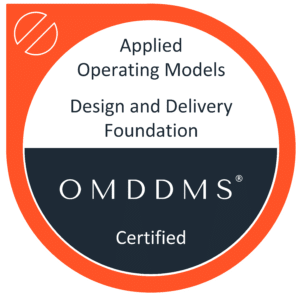
Once you’ve passed your exam, you’ll be able to use the following badge:
Our world-class expert instructors are industry leaders with extensive real-world experience. Known for their dynamic delivery and genuine passion, they transform complex theory into engaging classes through rich anecdotes and practical examples drawn from years in the field.

Alan is an Enterprise Architect has specialises in governance, privacy, information strategy and GDPR for over 25 years. Having trained 2,000+ practitioners globally, he blends deep and practical expertise in the TOGAF® framework and Applied Operating Models with real-world insights and experience. Alan’s engaging, experience-driven approach transforms complex frameworks into actionable strategic advantages.

Selina is a globally experienced transformation leader with 20+ years delivering large-scale organisational change across government, business and community sectors. Selina specialises in operating model design, workforce strategy and enterprise capability. Known for connecting theory to practice, she delivers engaging, practical learning that enables leaders and teams to drive meaningful, lasting change.
OMDDMS® is the Operating Model Design Delivery and Management Standard
OMDDMS® is the emerging standard for operating model transformation.
It was created so individuals and organisations can confidently modify operations for greater efficiency, profitability, and success.
By providing a repeatable, scalable method, guidelines, best practices, principles and structures, organisations can respond and change confidently, drive innovation, manage risk, and operate more efficiently and sustainably.
OMDDMS® training is only delivered through approved training providers.
Yes, it includes a comprehensive method with defined steps, inputs and outputs. This is the Operating Model Design and Delivery Method (OMDDM) and it supports operating model transition using a consistent, efficient, and practical approach that minimises risks, enhances collaboration, and drives the achievement of sustainable objectives and goals.
Consisting of seven phases (1 – 6) underpinned by continuous governance (7), the OMDDM ensures that the operating model is designed to support the organisation’s strategic goals and objectives. Each phase of the OMDDM has an objective, outcome, inputs, steps, and outputs.
This method also helps measure performance, scalability, and adaptability, contributing to the organisation’s success.
With OMDDMS® and the OMDDM, the answer to ‘What do we do on Monday?’ is clear.
The current version of OMDDMS® is Version 4.1.
To become certified, you must take the accredited course and pass the exam.
Exam vouchers will be made available via your training provider during your course or shortly after your course.
By searching on the OMDDMS® Certification Register (www.omddms.org/register), and soon, through Acclaim.
When you take an accredited course you will be asked whether you’d like your name to appear on the Certification Register to show attendance and certification status with a badge. You can also control this yourself through the MYOMDDMS facility.
Certification is provided for the version of the exam you take without any time limitation.
When either (a) new versions of the OMDDMS® AOM:DD course, or (b) additional (elective) modules or material are made available, you can choose to certify for each.
Take the first step to certification by registering yourself or your organisation for an upcoming public class.
Get in touch with one of our experts to find out more about the course and learn how we can meet your organisation’s requirements.
We’re excited to announce an upcoming course that’s just around the corner! Register your interest by completing the form below, and you’ll be amongst the first to receive updates and exclusive details about the course. One of our team members will be in touch soon!
At EA Learning, we support organisations to plan and deliver effective training while making the most of their training budgets. We can assist in a number of ways, including:
Please complete the form below and a member of our specialist team will be in touch shortly to discuss your requirements and recommend suitable options. We look forward to supporting your team’s development.